
Google SEO Penalty Recovery Case Study: How I Lost 100% of My Traffic (Real Data, Ongoing)
TL;DR: My personal website, alstonantony.com, lost nearly 100% of its organic traffic following the November 2024 Google Core Update. This is a live, ongoing case study documenting every step of my SEO penalty recovery. You will see real Google Search Console data, the exact mistakes that made my site vulnerable, every technical and content fix I have applied so far, and the roadmap ahead. Nothing is fabricated. Part 1 covers the diagnosis. Part 2 covers the first wave of fixes. Part 3 is coming.
I logged into Google Search Console on a routine check and saw something I have seen on client sites before. I had never expected to see it on my own.
A vertical drop. Not a gradual slide. A cliff.
My site went from growing steadily to near-zero traffic almost overnight. And honestly, that data does not need much explanation. The chart tells you everything before I say a single word.
This is my personal website. I have 15+ years of SEO experience, an MSc in Software Engineering, and I have helped clients recover from Google penalties before. Yet here I was, staring at the same GSC graph I had diagnosed for others, except this time the domain in the URL bar was mine.
This is a live case study on google penalty recovery for alstonantony.com. I am documenting every single step, every fix, every failure, and every sign of progress publicly. Not to sell a course. Not to pitch a service. Because this is the only honest way to validate what I teach, and because real case studies are rarer than they should be in the SEO world.
If your site has been hit by a Google algorithm update, this series will show you the exact thinking process behind a structured recovery. Follow along, and learn from what I am going through in real time.
Part 1: The Diagnosis (Video)
Watch Part 1 of this case study series, where I show the GSC data live and walk through the exact updates that hit my site.
What the Google Search Console Data Actually Showed
The first tool I open for any SEO issue is Google Search Console. Not Ahrefs. Not Semrush. GSC. Third-party tools give you estimates. GSC gives you what Google actually recorded.
I set the date range to 16 months so I could see the full picture, not just recent activity. The pattern was clear.
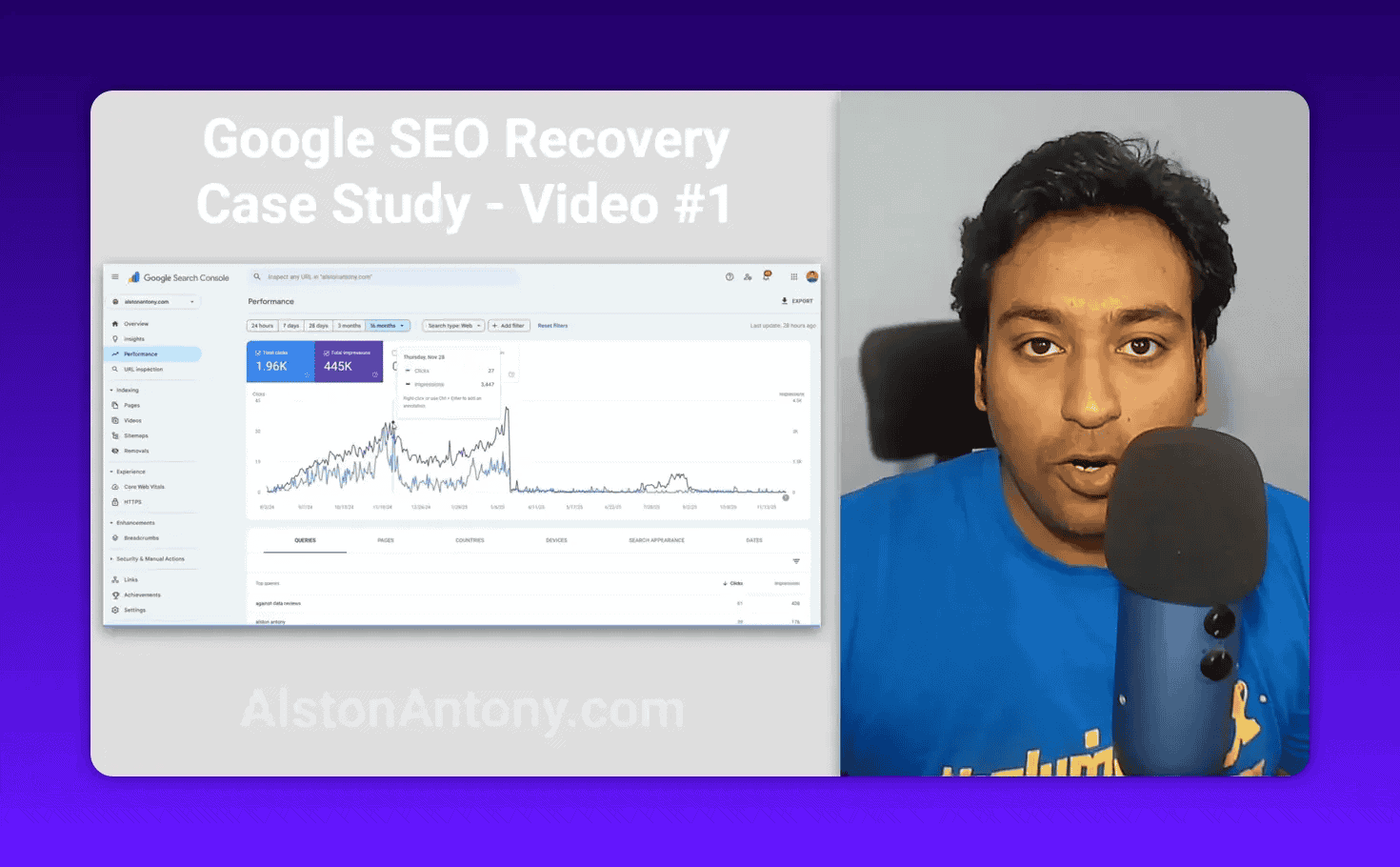
My site was growing consistently until November 28, 2024. Then the drop happened. Fast, sharp, not gradual.
What followed was a partial recovery around March 14, 2025, which looked promising at the time. Then another hit. After that second drop, the site entered what I call the flat line: minimal impressions, minimal clicks, almost no life in the data.
This is the chart that launched this case study series.
I also checked Bing Webmaster Tools. No usable data there either, which confirmed the site had not established any meaningful presence outside Google at that point.
For traffic trend validation, I cross-checked three third-party tools alongside GSC.
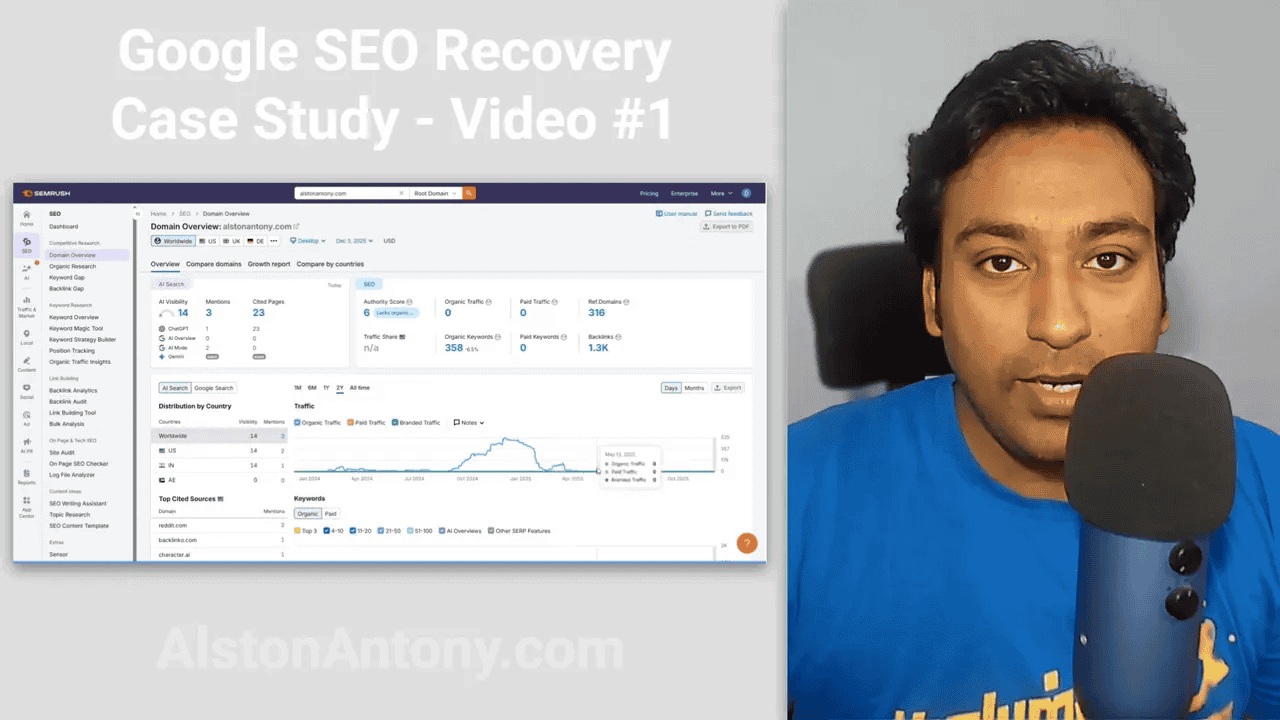
The tools agreed directionally but not precisely. One showed a single drop period. Ahrefs was closer to accurate, catching both the drop and the brief recovery surge. A lifetime deal SEO tool I was testing also flagged the same pattern. None of them matched GSC exactly, which is exactly why I always tell people: trust GSC first.
How I Confirmed It Was a Google Algorithmic Penalty
When you see a sharp traffic drop, the first question is not “what do I fix?” The first question is “what caused this?”
There are two types of Google penalties: manual and algorithmic. A manual penalty shows up directly inside Google Search Console under Security and Manual Actions. I checked. Nothing there.
That left an algorithmic hit, which is caused by a core update, a spam update, or a product review update changing how Google evaluates your site.
My first step was to cross-reference the drop dates with known Google updates. I used the Google penalty checker tool I built for exactly this purpose. You select the year and month, and it shows all Google updates that occurred during that window.
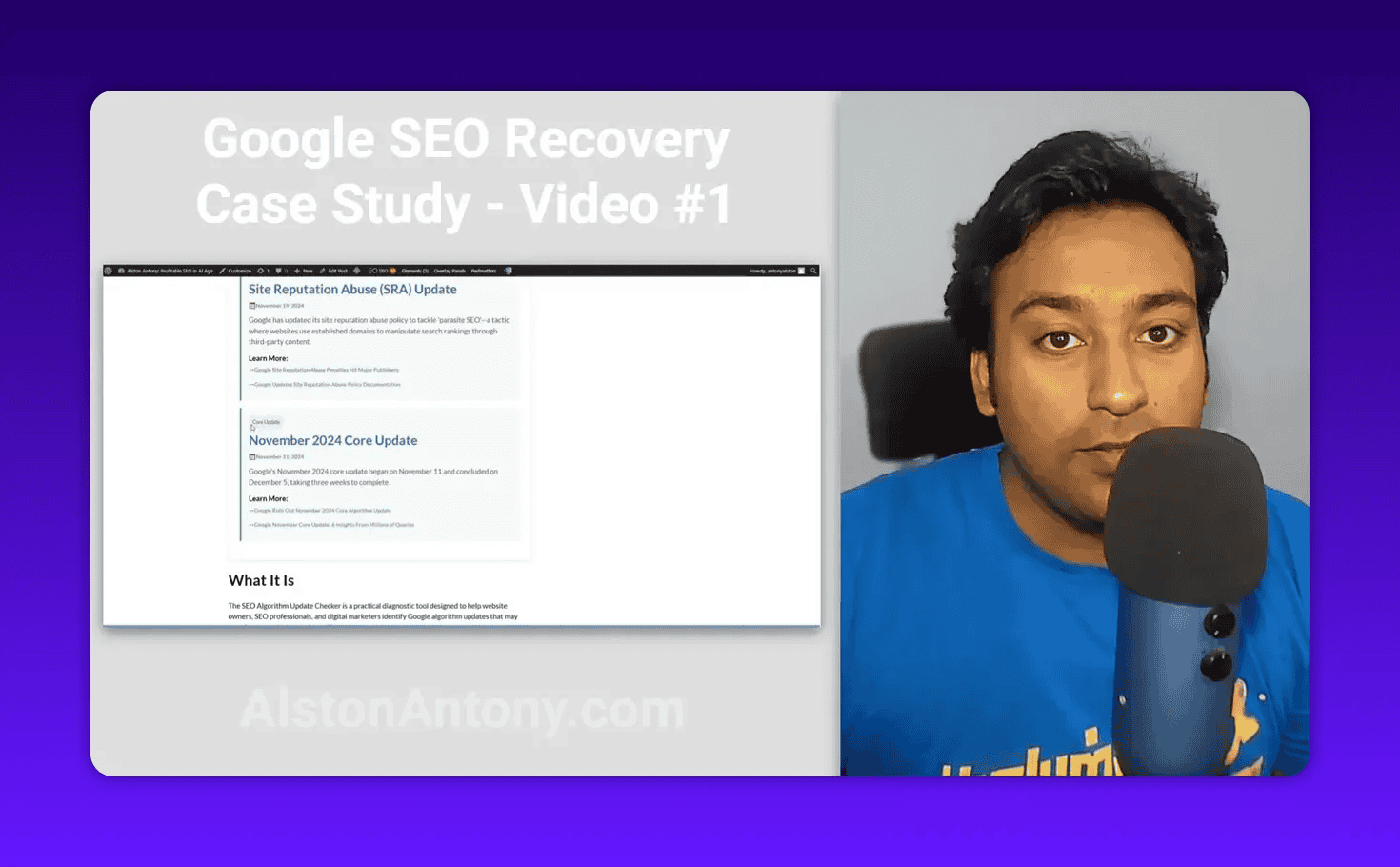
The results confirmed two separate hits:
November 2024 Core Update: Began November 11, 2024. Concluded in December 2024. This is the update that caused the initial traffic cliff. Core updates typically take several weeks to fully roll out, and recovery from them can take months. This update targeted site-level quality signals, not individual pages.
March 2025 Core Update: This is what knocked the partial recovery I had seen in early 2025. I started to climb back, which was a good sign, then this second update came through and reset the progress.
Two core updates in quick succession. The first revealed the underlying problems with my site. The second confirmed they had not been fixed.
Understanding this sequence matters for seo recovery strategies. A core update does not create problems on your site. It reveals problems that already existed. Google changed how it weights certain signals, and my site failed the new evaluation. That is a different diagnosis than a spam update or a manual penalty, and it requires a different recovery approach.
For more context on how these updates work and a complete history, see my Google algorithm updates and SEO penalties guide.
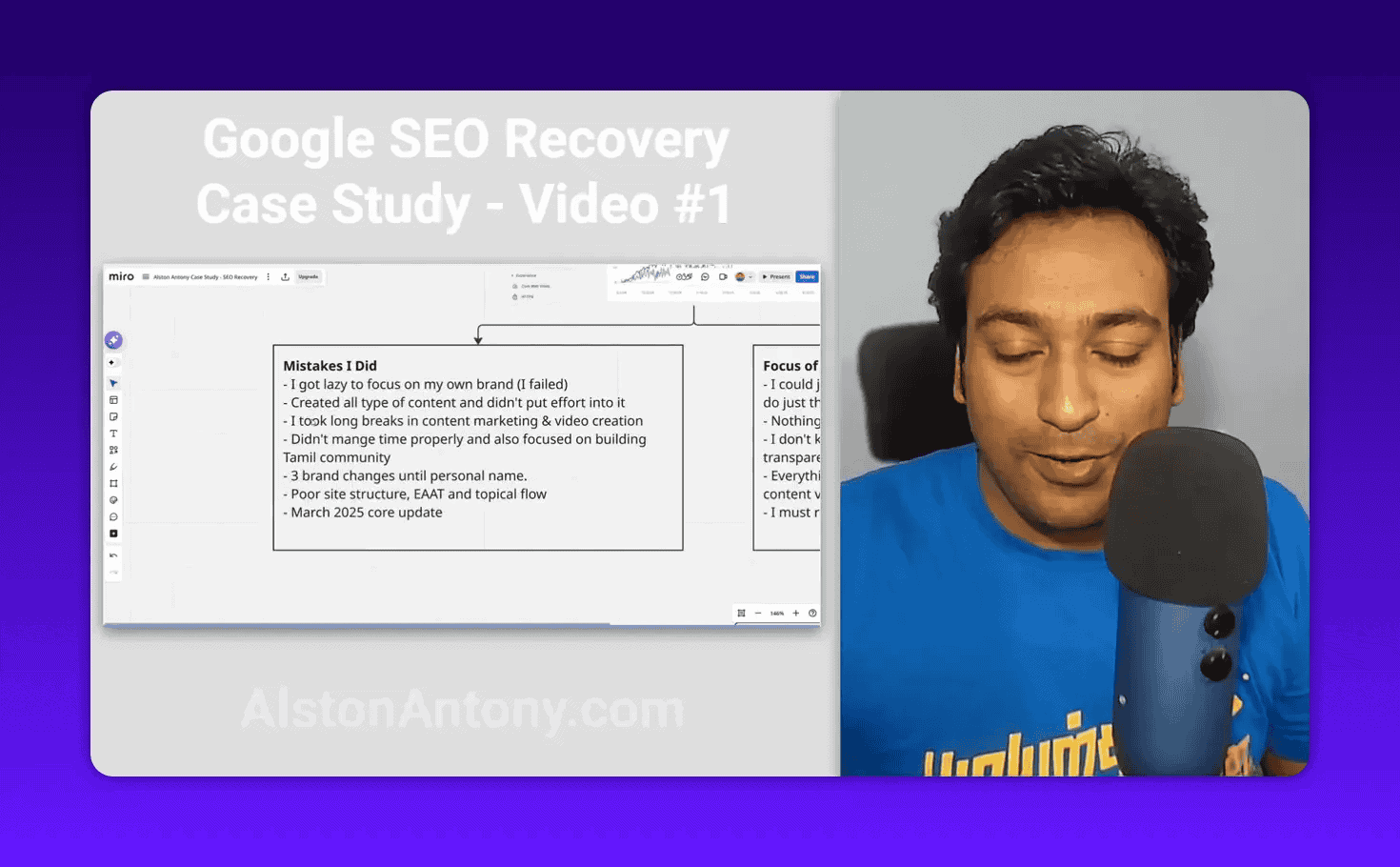
The 5 Mistakes That Made My Site Vulnerable
Here is what I do not see enough of in SEO content: the honest part. Most case studies start at the recovery. They skip the part where the site owner admits what went wrong.
I am not doing that.
These are the five specific mistakes I made that left my site exposed to algorithmic hits. If you are in a similar situation, chances are you will recognize at least one of these.
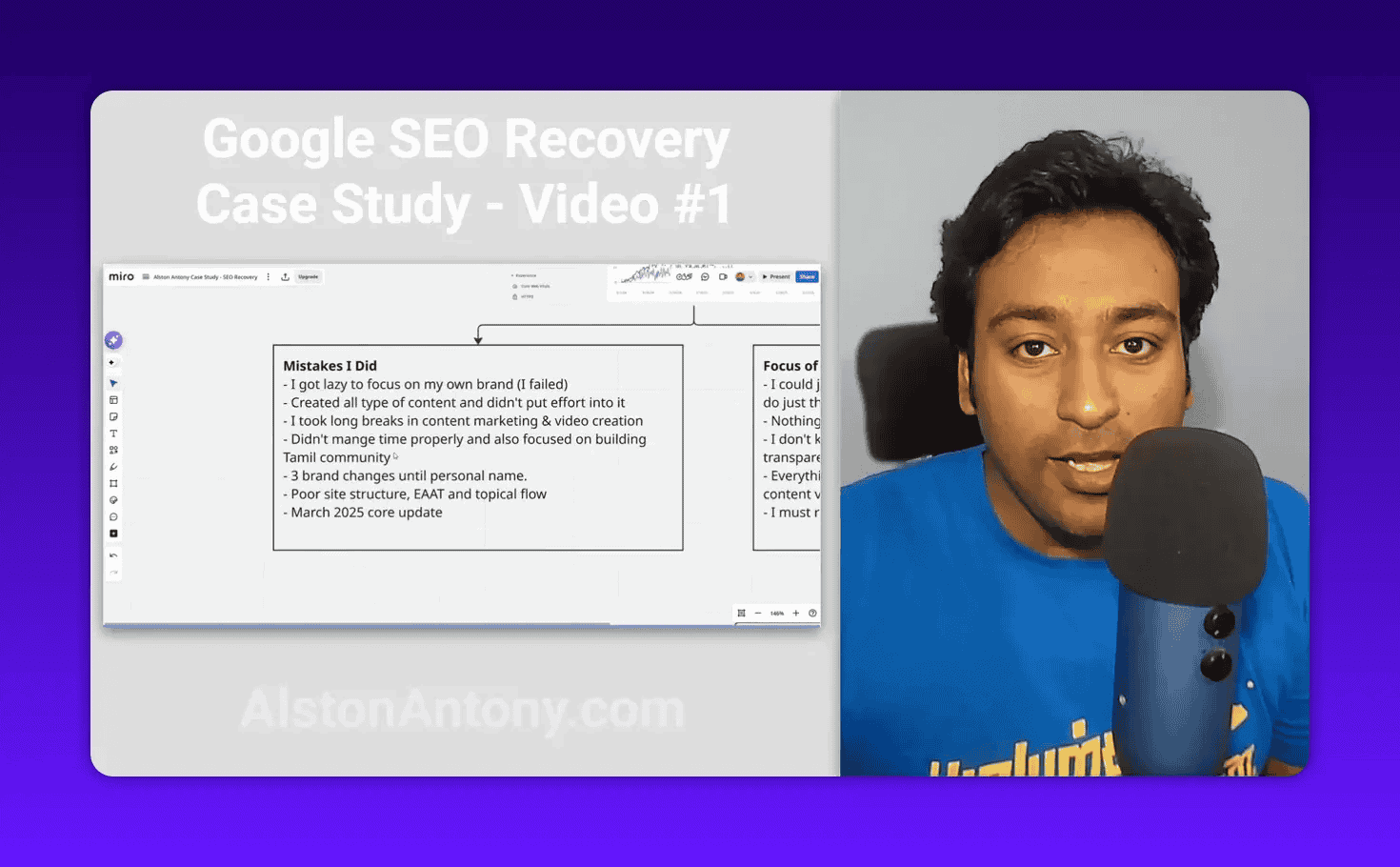
Mistake 1: I Created Content for Vanity Metrics, Not Topical Authority
This one is the most common mistake I see, and I made it myself.
I went after low-competition, low-search-volume keywords because that is what the standard SEO advice says to do when you are building a newer site. Find the low-hanging fruit. Get some quick wins. Build momentum.
The problem is I applied this indiscriminately and stopped asking whether the content was actually relevant to my brand.
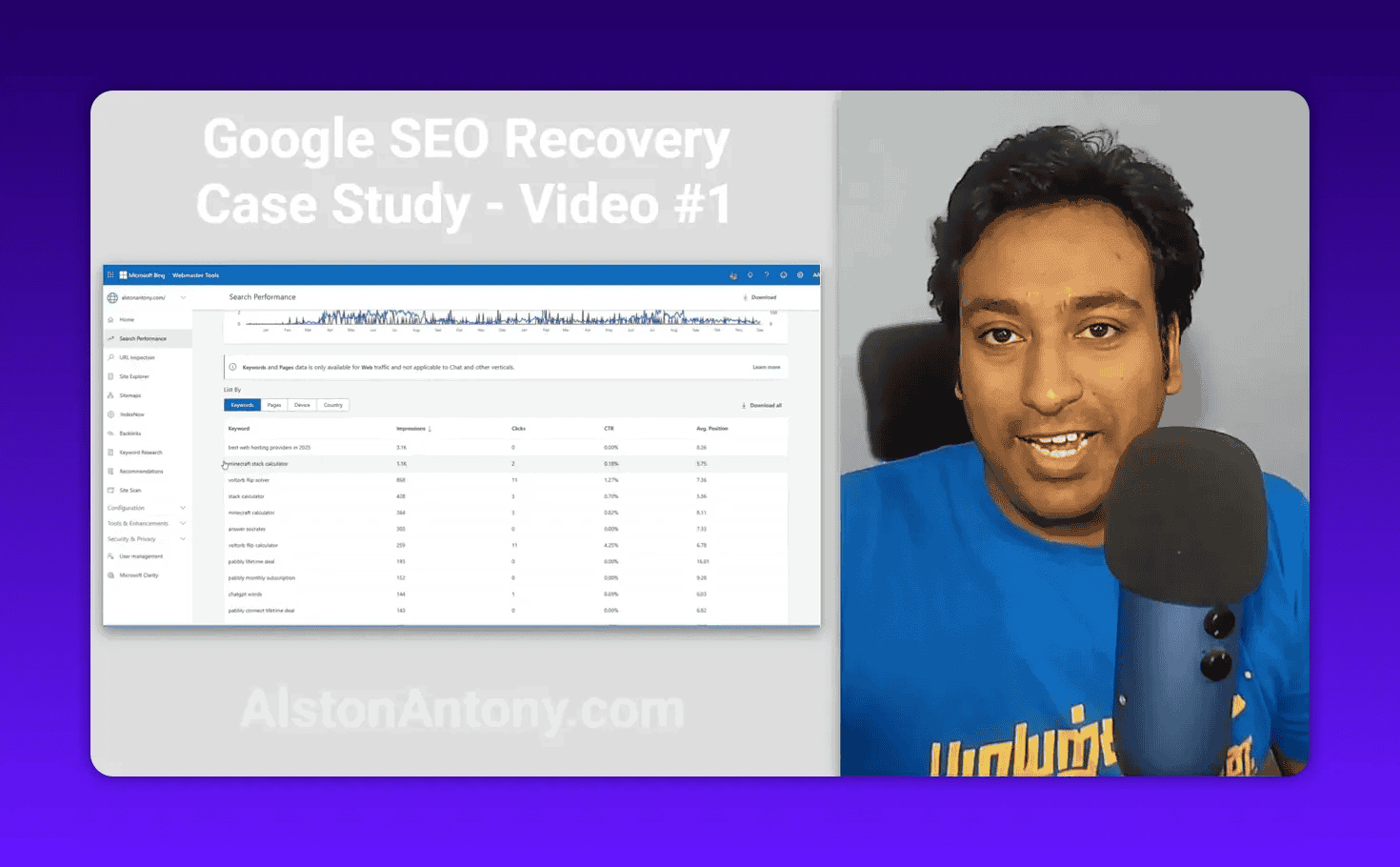
If you look at the GSC keywords data for the period before the drop, you will see impressions coming from: Minecraft calculators, suburb postal code lists, business name generators for clothing and beauty products.
None of those have anything to do with SEO tools, digital marketing, or my core audience. I created that content because it had low competition and some search volume. I published it, moved on, and never considered what it was doing to my topical authority.
Google’s core updates increasingly evaluate sites based on whether they demonstrate genuine expertise on a defined topic. A site that ranks for Minecraft calculators and Semrush tutorials sends a confused signal about what the site is actually about and who it serves.
This was the biggest contributor to the ranking collapse.
Mistake 2: I Took Long Breaks from Content Creation
Look at my YouTube channel upload history and you will see visible gaps. Those same gaps exist across my entire content operation.
Life happened. I went back to Sri Lanka for an extended period. My daughter was born. Agency client work increased. My Tamil digital marketing community was growing faster than my English site and deserved more attention. All legitimate reasons. All still mistakes in terms of what they did to this site.
Search engines reward consistent activity. Links go stale. Fresh content signals active maintenance. When a site goes quiet for extended periods, it is easier for Google to deprioritize it in favor of competitors that are actively maintained.
The irony is that my Tamil site at digitalmarketingtamil.com was ranking number one for its target keywords during this period. I proved I knew how to do this. I just was not applying it consistently to my own English brand.
Mistake 3: Three Brand Changes Destroyed Link Equity
This one is painful to admit because it was a long-term compounding error.
The site started as clickto.com. I rebranded to Digital Marketing Mind because I wanted something more descriptive. Then I shifted again to alstonantony.com when I understood the value of personal branding and building around my own name.
Three domain changes. Three waves of link reclamation work. Every backlink pointing to the old domains needed to be either redirected correctly or actively reclaimed through outreach.
301 redirects help. They do not fully solve the problem. Every domain change introduces some link equity loss, some anchor text dilution, and some domain age reset in terms of trust signals. I went through that three times.
If you are building a personal brand or any serious digital asset, choose your domain name carefully and commit to it. The cost of changing it later is far higher than the short-term discomfort of sticking with a name you are not fully sure about.
Mistake 4: Poor Site Structure and Topical Architecture
The site had no clear topical hierarchy. Categories were spread across too many topics with no organizing logic. There was no clear signal to Google about what the site was authoritative on or who it was built for.
When Google evaluates a site for a core update, it looks at the entire site, not just individual pages. A site that appears to cover everything often convincingly covers nothing. The algorithmic evaluation found that my site did not meet the threshold for demonstrating genuine topical expertise in a defined area.
Mistake 5: Weak E-E-A-T Signals
My about page was generic. Author bios on articles were thin or missing. There were no clear credentials, no testimonials, no verification that a real expert was behind the content.
Google’s Helpful Content guidelines emphasize Experience, Expertise, Authoritativeness, and Trustworthiness. A site where none of those signals are visible on the page is easier to discount algorithmically than one where the author’s credentials are clear and verifiable.
I had the credentials. MSc in Software Engineering. 15+ years of experience. BCS Professional Member. I just was not making any of that visible or verifiable within the site itself.
The Recovery Plan I Built
After diagnosing the problems, I built a structured recovery roadmap using Miro to map out the full timeline, working backwards from where the site needed to be.
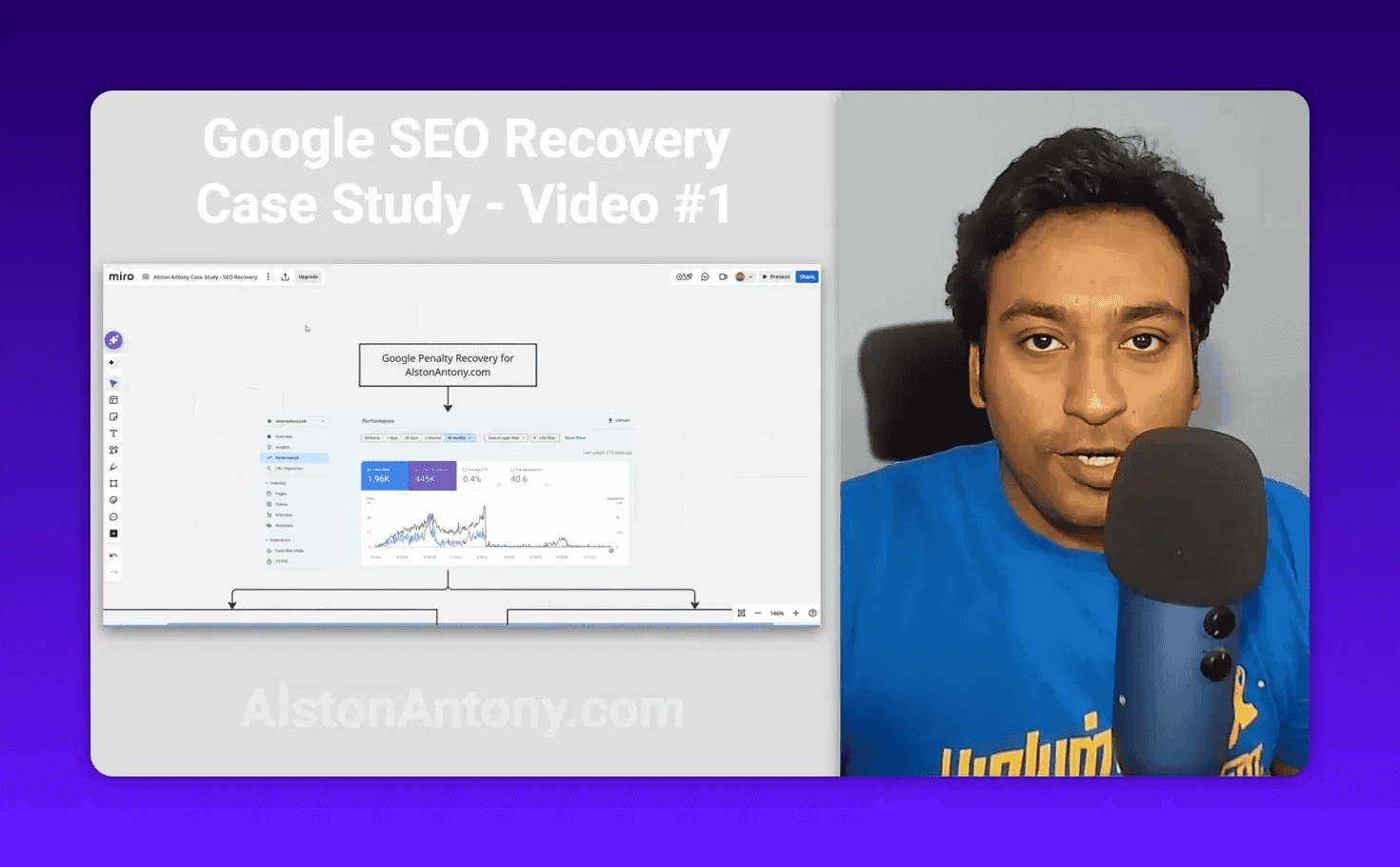
The plan breaks into four phases:
Phase 1: Technical fixes. Clean up all the structural issues first. Fix what Google can crawl, index, and evaluate properly before worrying about anything else.
Phase 2: Content audit and rewrite. Remove thin pages. Merge fragmented content. Rewrite the highest-traffic and highest-impression pages to meet a genuine quality standard.
Phase 3: Off-page recovery. Backlink audit, reclamation of links from old domains, and a structured outreach plan to build authority signals.
Phase 4: AI search optimization. Google is not the only search engine that matters in 2026. Build visibility in ChatGPT, Perplexity, and Google AI Overviews in parallel with traditional SEO recovery.
I am currently mid-Phase 2. Here is what Phase 1 accomplished and where Phase 2 stands.
Part 2: Recovery Actions Taken (Video)
This video covers the first substantive wave of work: the full site revamp, content audit results, and the article rewrite workflow I built.
What I Found in the Full Content Audit
The content audit results were sobering.
After running a full crawl and manually evaluating every page category, I found:
- 349 thin content pages removed from the site
- 440 broken links fixed
- 92 live outbound links remaining after cleanup
- ~90 junk internal links removed
The number that hit hardest: approximately 12.7% of my total site content was genuinely useful. The rest was thin, irrelevant, outdated, or duplicate in search intent.
That means roughly 87% of the pages on my site were either hurting me or contributing nothing. This is not unusual for sites that published aggressively over several years without a structured content quality process. But seeing it as a number is still a shock.
Actions taken from the audit:
Most of the deal posts were thin pages with no real content depth. Those were removed. Pagination URLs and feed URLs were set to no-index since they were consuming crawl budget without providing indexable value. The URL structure was simplified from a long category chain to a clean, flat architecture closer to the domain root.
Keyword cannibalization was also an issue. I had two articles on ChatGPT overused words that were competing for the same keyword cluster. Those were merged into a single authoritative piece. One article was targeting “SEO tutorial” but the primary keyword was not in the title tag. Fixed.
The Site Architecture Overhaul
The previous site had categories scattered everywhere with no organizing logic. The new architecture reduced everything down to five focused categories:
- SEO Tools (reviews, tutorials, comparisons)
- SEO Strategy (guides, case studies, frameworks)
- Free SEO Tools (utilities I built)
- SEO Deals (lifetime deals, discounts)
- YouTube (video content index)
This is what Google’s helpful content guidance actually means in practice. Not writing shorter articles. Not removing content indiscriminately. Building a site where the topical focus is immediately obvious to both users and crawlers.
The homepage was rebuilt from scratch. Credentials are now clearly visible. Statistics are shown. The topic clusters are mapped out so anyone landing on the site knows immediately what it is about and who built it.
For site speed: the rebuilt site scores 95 to 100 on desktop performance and 85 to 90 on mobile. Speed is one fewer reason for Google to discount the site.
Article Rewrites: The Quality Score Results
For the highest-traffic pages and highest-impression pages, I built a content workflow using Claude Code that evaluates each article across five quality dimensions and returns a composite score out of 100.
The starting scores for the priority articles ranged from 52 to 58. After rewriting with proper structure, answer capsules, internal links, comparison tables, and author signals:
- Article 1: 52 to 91
- Article 2: 52 to 80
- Article 3: 58 to 85
These are not just word count increases. The rewrites include:
Proper heading hierarchy. H2 headings that match the way users actually ask questions, so the content aligns with search intent and gets picked up by AI answer engines.
Answer capsules. Each question-based H2 now opens with a direct 40 to 60 word answer before expanding into detail. This is what AI search engines extract when they cite sources.
Internal links. The Semrush tutorial series, for example, now links to 12 related internal pages rather than the 2 or 3 it had before.
Author signals. First-person testing evidence in every article. Screenshots from the actual tools I used. YouTube video embeds from my channel to verify hands-on experience.
Schema. FAQ schema, Article schema, HowTo schema, and Review schema are now applied consistently across article types.
If you want to understand what a properly structured article looks like from a crawlability and AI citability perspective, read my guide on how AI search engines work.
AI Search Optimization: Why Google Is Not the Only Focus
Part of the reason I started this case study was that the SEO world changed significantly during the period I was neglecting this site. Google AI Overviews launched. ChatGPT added web browsing. Perplexity became a real traffic source.
Waiting for Google to fully restore rankings while ignoring every other search channel is not a viable recovery strategy in 2026.
From my Google Analytics data for the most recent 90-day period, I am already seeing:
- YouTube referral traffic that is consistent month-over-month
- Bing organic search improving (clicks grew from 18 to 35, impressions from 2,800 to 3,200 in the comparison period)
- ChatGPT referral traffic appearing in GA4 as a source
- Facebook referral traffic from consistent social media distribution
The Bing improvement is particularly meaningful. Bing does not benefit from the same brand authority signals that Google rewards from established sites. It evaluates content quality and technical structure more directly. Seeing Bing respond positively to the technical and content fixes before Google does is a predictive signal that the changes are working.
For AI search specifically, the changes I made follow the principles I call answer-first architecture:
- Every question-based heading is followed immediately by a direct answer paragraph
- Comparison tables are included wherever I discuss tools or options side by side
- TL;DR summaries appear at the top of long-form articles
- FAQ sections at the bottom of every post target the specific sub-questions that AI engines fan out into when answering a complex query
For a detailed breakdown of these techniques, see my post on tracking AI search visibility with Morningscore and the Knwn AI SEO tool review which tracks brand mentions across ChatGPT and Gemini.
Building Trust Signals That AI and Google Both Respond To
The single biggest lesson from studying how Google’s Helpful Content system works is this: search engines are no longer just evaluating content. They are evaluating whether a real expert produced it.
That means trust signals are no longer optional. They are core recovery infrastructure.
Changes I have made:
Author schema on every page, linked to my about page with full credentials listed: MSc Software Engineering, BCS Professional Member, 15+ years SEO experience, 30,000+ students taught.
First-person evidence in every article. I do not describe tools. I show what I see when I use them on my actual sites. Screenshots of the real interface. Not stock photos. Not demo accounts.
Video embeds from my YouTube channel inside articles. This is not just for engagement. It signals to both Google and AI engines that the author has publicly verifiable expertise in this topic. Anyone can check the channel and confirm the content is real.
Lead capture and email list. Not directly an SEO factor, but a trust infrastructure signal. A site that has no email list, no community, and no return visitors is a site that real users apparently do not value enough to come back to. Building that asset also builds the behavior signals that search engines measure.
Testimonials. Social proof from real students and community members is now visible on the site, anchored with real names and context.
Current Status and What Comes Next
This is where the case study stands at the time of the most recent update (June 2026):
Google organic traffic: Still suppressed. No significant ranking recovery visible yet. Core update recoveries typically take three to six months after the underlying issues are fixed. The technical and content work is recent. Patience is required.
Bing: Showing clear improvement. Clicks and impressions both up in the comparison period. Bing often responds faster than Google to on-page quality improvements.
AI search: ChatGPT and DuckDuckGo referral traffic visible in GA4. Not a large volume yet, but consistent and growing.
Content audit: Complete. Thin pages removed, broken links fixed, URL structure cleaned up.
Article rewrites: In progress. The top 6 to 7 pages by impressions have been rewritten. Working through the next tier.
Off-page: Not started yet. I will not begin link reclamation or new link building until the on-site work is complete. Building links to a poorly structured site is wasted effort.
Phase 3 roadmap (next steps):
- Complete article rewrites for the top 30 pages by impression volume
- Run a full schema audit and fill any missing markup
- Build a Google Indexing API integration to submit rewritten pages for faster re-crawl
- Begin backlink audit: identify links pointing to old domains and prepare reclamation outreach
- Start structured link building once on-site work passes a full re-evaluation
I will document every one of these steps in this article and in the video series. If you want to follow along in real time, subscribe to the YouTube channel and join the email newsletter.
What You Should Take Away From This Right Now
If your site has been hit by a Google algorithmic penalty, here is the thinking process that applies regardless of your niche:
Step 1: Confirm it is algorithmic, not manual. Check Security and Manual Actions in GSC first. If it is clean, you are dealing with an algorithmic hit.
Step 2: Match the drop date to a known update. Use the Google penalty checker tool or check Search Engine Journal’s Google algorithm update timeline. Knowing which update caused the drop tells you what it was evaluating.
Step 3: Audit your content for topical relevance. Every page that has no clear connection to your core topic is either a neutral signal or a negative one. Remove or redirect thin pages.
Step 4: Fix technical issues before anything else. Broken links, redirect chains, bloated category structures, pagination that is indexed when it should not be. These are all signals Google uses to evaluate site quality.
Step 5: Rebuild every page with genuine depth. Not longer for the sake of length. Genuinely more useful: direct answers, comparison tables, real screenshots, verified data sources, proper schema.
Step 6: Build trust signals that humans and algorithms can verify. Author credentials on every page. First-person evidence. Video content linked to a verifiable channel. A real presence that demonstrates you are the actual expert behind the content.
Step 7: Be patient and document everything. Core update recoveries take months. The recovery work you do today will not show results in two weeks. Document the changes you are making so you can track what worked and what did not.
Recovery is possible. Not guaranteed. Not fast. But documented, methodical, honest work does eventually show results.
If you want to follow this recovery as it happens, subscribe to my weekly email newsletter where I share progress updates, tool finds, and SEO insights every week.
Frequently Asked Questions About Google SEO Penalty Recovery
How long does it take to recover from a Google penalty?
Recovery from a Google algorithmic penalty typically takes three to six months after the underlying issues are fixed. Core update recoveries can take longer because Google re-evaluates sites incrementally as it rolls out future updates. There is no fixed timeline, and recovery is never guaranteed, but methodical on-page and technical improvements are the most reliable path forward.
What is the difference between a manual penalty and an algorithmic penalty?
A manual penalty is applied by a human Google reviewer and appears directly in Google Search Console under Security and Manual Actions. It has a specific reason listed and can be removed by submitting a reconsideration request once the issue is fixed. An algorithmic penalty is caused by a Google algorithm update changing how the system evaluates your site. It does not appear in GSC and cannot be resolved by a reconsideration request. It resolves only when Google’s algorithm re-evaluates your site and finds the quality signals have improved.
How do I check if my site was hit by a Google algorithm update?
Cross-reference your GSC traffic drop dates with known Google update timelines. Use the free Google penalty checker tool to see what updates ran during any given month. Compare the dates against Search Engine Journal’s algorithm update tracker for additional confirmation. If the drop aligns with a known update rollout, you are dealing with an algorithmic hit.
What mistakes most commonly cause Google algorithmic penalties?
The most common causes are: publishing content with no topical relevance to your core niche, thin or low-value pages diluting site quality, weak E-E-A-T signals (no visible author credentials, no first-person evidence), poor site structure with no clear topical hierarchy, and inconsistent site maintenance over time. Core updates evaluate the entire site, not individual pages, so these site-level issues are the primary targets.
Can I recover from a Google penalty without professional help?
Yes. The recovery process is methodical rather than mysterious. It requires a full content audit, technical SEO fixes, article rewrites focused on genuine depth, and patience. The steps are well-documented and can be executed without hiring a google penalty consultant, although professional help can accelerate the process if you are time-constrained. This case study documents the exact process I am following on my own site, step by step.
Is this case study still ongoing?
Yes. I will continue updating this article and publishing new videos in the series as the recovery progresses. Part 3 will cover the next phase of article rewrites and the beginning of off-page work. Subscribe to stay updated.
Last updated: June 11, 2026. This is a live case study. Data and findings will be updated as the recovery progresses.
📌 Part 3 — Coming Soon
Part 3 will cover the next phase: rewriting thin content at scale, rebuilding topical authority, and the first signs of recovery in GSC. Subscribe to the newsletter to get notified the moment it goes live.
Continue Following This Case Study
If this was useful, subscribe to the email newsletter for weekly updates. I share real data, what I am testing, and what is working, without the hype.