
TL;DR: A free ChatGPT-powered GPT called “Local SEO for Small Business AI” handles keyword research, Google Business Profile optimization, NAP citations, backlink strategy, social media setup, and even content generation. You just type your business type and location. No SEO agency required.
Most small business owners I talk to are paying $500 to $2,000 a month for local SEO services they barely understand. The agency sends a monthly PDF with some rankings data. Traffic goes up, sometimes. Or it doesn’t, and the agency explains that “SEO takes time.” Meanwhile, the invoice keeps coming.
I built something different: a free AI assistant that walks you through every piece of local SEO, step by step, tailored to your specific business and city. It is not a replacement for deep SEO expertise. But for the overwhelming majority of small businesses, it gives you more actionable guidance than most agencies ever do, and it costs nothing.
This is a hands-on walkthrough of the free Local SEO GPT I created. I will show you exactly what it does, how to use it, and what real outputs look like when you test it on an actual business scenario.
What Is the Free Local SEO GPT?
The free Local SEO GPT is a custom ChatGPT assistant built specifically for small business owners who want to improve their local search rankings without hiring an agency or learning SEO from scratch.
You can access it here: Local SEO for Small Business AI. A free ChatGPT account is all you need.
The assistant covers the full local SEO workflow:
- Local keyword research (including seasonal and event-based terms)
- Google Business Profile (GMB) optimization
- NAP (Name, Address, Phone) citation consistency
- Online review management strategy
- On-page SEO for your website
- Local backlink opportunities
- Social media profile setup and content strategy
- Image generation for your profiles and pages
What makes it different from just asking ChatGPT a local SEO question is context. You tell it your business type and location once, and it tailors every answer to your specific situation. A bakery in Coimbatore gets different keyword targets, different backlink sources, and different seasonal content ideas than a plumber in Manchester or a yoga studio in Austin.
I built it in about 2 to 3 hours. It is still in beta. But even in its current state, the outputs it produces are more specific and actionable than most generic SEO advice you will find online.
How to Access and Start Using It
Go to this link: https://chat.openai.com/g/g-yS2XtC16Y-local-seo-for-small-business-ai
You need a free ChatGPT account. Once you open the GPT, you will see four conversation starters, but you are not limited to those. The best way to start is simply to tell it:
- What type of business you run
- Your street, neighborhood, or city
- What you want help with first
That is it. The GPT takes your context and builds every response around it. If you mention your bakery is on Race Course Road in Coimbatore during your first message, it will reference that location in every keyword suggestion, subpage recommendation, and social media bio it generates for the rest of the conversation.
You are not locked into any fixed workflow. You can jump from keyword research straight to backlink strategy, then back to asking it to write a sample page for a specific keyword. The conversation history is saved, so you can come back to it later without starting over.
Local Keyword Research: What the GPT Actually Produces
Keyword research is where most small business owners feel completely lost. “What do I search for? How do I know if anyone is searching for it? What does search volume even mean?”
I ran the GPT through a real test: a small bakery in Racecourse, Coimbatore.
First, I asked a general question: “How can I improve my local SEO?” The GPT gave me a structured overview covering keyword research, Google Business Profile, citations, reviews, on-page optimization, and backlinks. Useful orientation, but not yet specific enough to act on.
So I went deeper. I asked: “I run a small bakery in Racecourse, Coimbatore. Suggest more detailed info on keyword research.”
The output walked me through:
1. Understanding the customer base. What do bakery customers actually search for? Birthday cakes, fresh bread, custom cakes, pastries, party orders. Not just “bakery.”
2. Localizing the keywords. Adding “in Racecourse” or “in Coimbatore” to each product keyword. “Birthday cakes in Racecourse.” “Fresh bread in Coimbatore.” These localized phrases are what people type when they are ready to buy, close to where you are.
3. Keyword tools to use. It named Google Keyword Planner, Ubersuggest, and Semrush, and explained how to pull search volume and competition data for each term.
4. Seasonal and event-based terms. This is where it got interesting. The GPT understood local Indian events, not just generic Western holidays. It flagged Diwali (connected to sweets) and Christmas (connected to Christmas cakes) as high-opportunity seasonal search windows for a bakery in Coimbatore. That kind of local cultural awareness is rare even in paid SEO tools.
5. Long-tail keyword prioritization. It generated a table showing high-priority terms (specific, local, lower competition) alongside broader terms, helping me see where to focus content first.
All from one targeted question. The key is specificity. The more detail you give it upfront, the more actionable the output.
Building a Subpage Strategy with Long-Tail Keywords
Most small business websites have one page: the homepage. That is a massive missed opportunity. Each product or service you offer could have its own dedicated page targeting a specific long-tail keyword. Google can rank each page independently.
I asked the GPT: “With topical relevance, suggest the subpages I should create for my bakery website.”
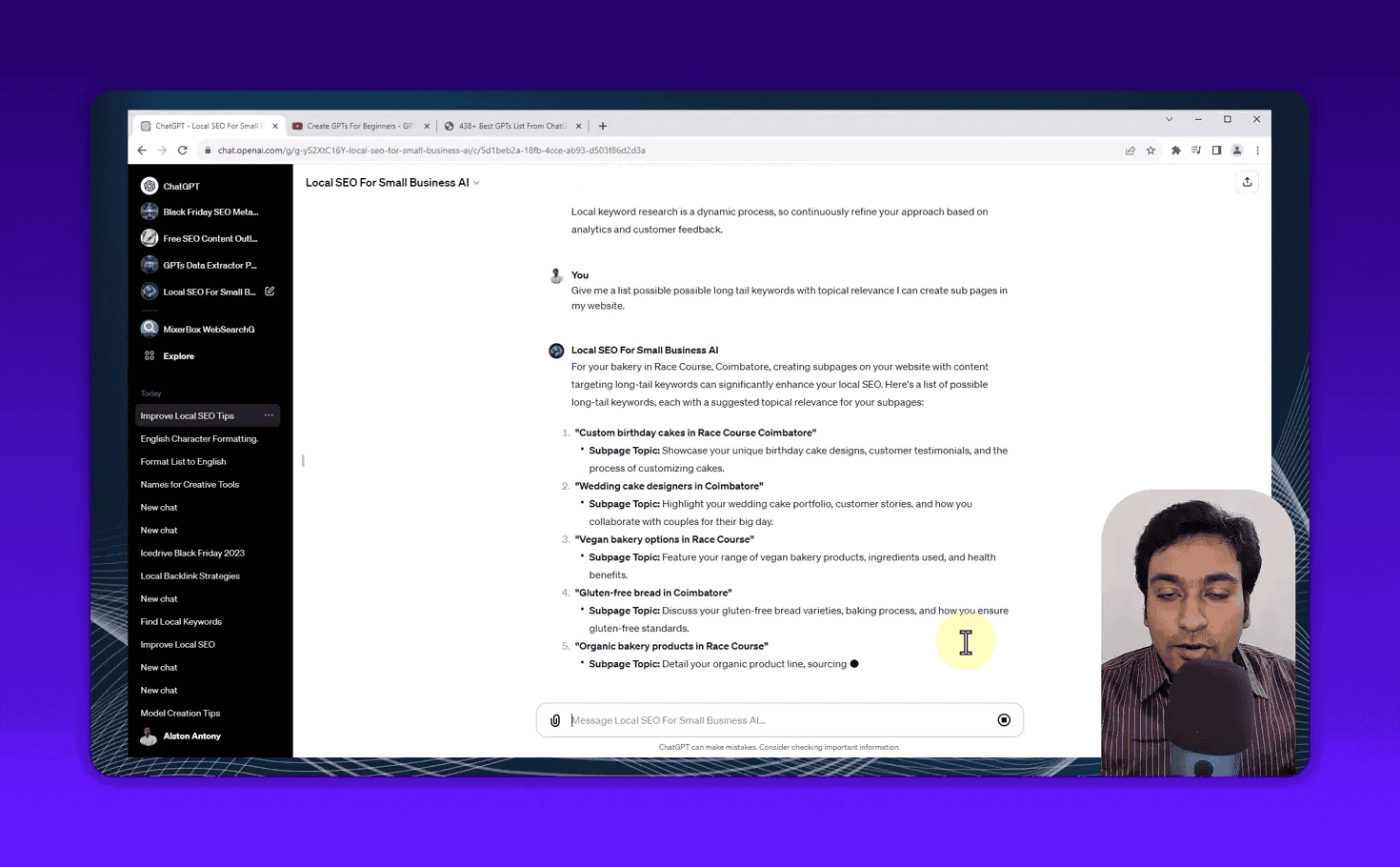
The GPT produced a list of subpages, each anchored around a long-tail keyword with clear content guidance:
- “Custom Birthday Cakes in Racecourse, Coimbatore” — Target keyword. Page should showcase cake designs, include a customization process walkthrough, and feature customer testimonials.
- “Wedding Cake Designers in Coimbatore” — Highlight the wedding cake portfolio, collaboration process, and couple testimonials.
- “Vegan Bakery Options in Racecourse” — Cover ingredients, allergen information, and FAQs about gluten-free alternatives.
- “Fresh Pastry in Coimbatore” — Focus on daily freshness, sourcing, and what makes your pastry different.
- “Organic Bakery Products in Racecourse” — Ingredient sourcing, certifications, health benefits.
Each suggestion came with guidance on what the page content should include, how to use the keyword naturally in titles and headers, and what kind of visuals to feature. This is not a feature list. It is a working content strategy you can hand to a developer or implement yourself on any CMS.
This is the same framework a content agency would build for you at significant cost. Here, it came from a free tool responding to one question.
Generating Actual Page Content
Strategy is one thing. Writing the actual words for each page is another. I pushed the GPT further.
I asked: “For the keyword you suggested, generate me a sample content for the page, including title and text.”
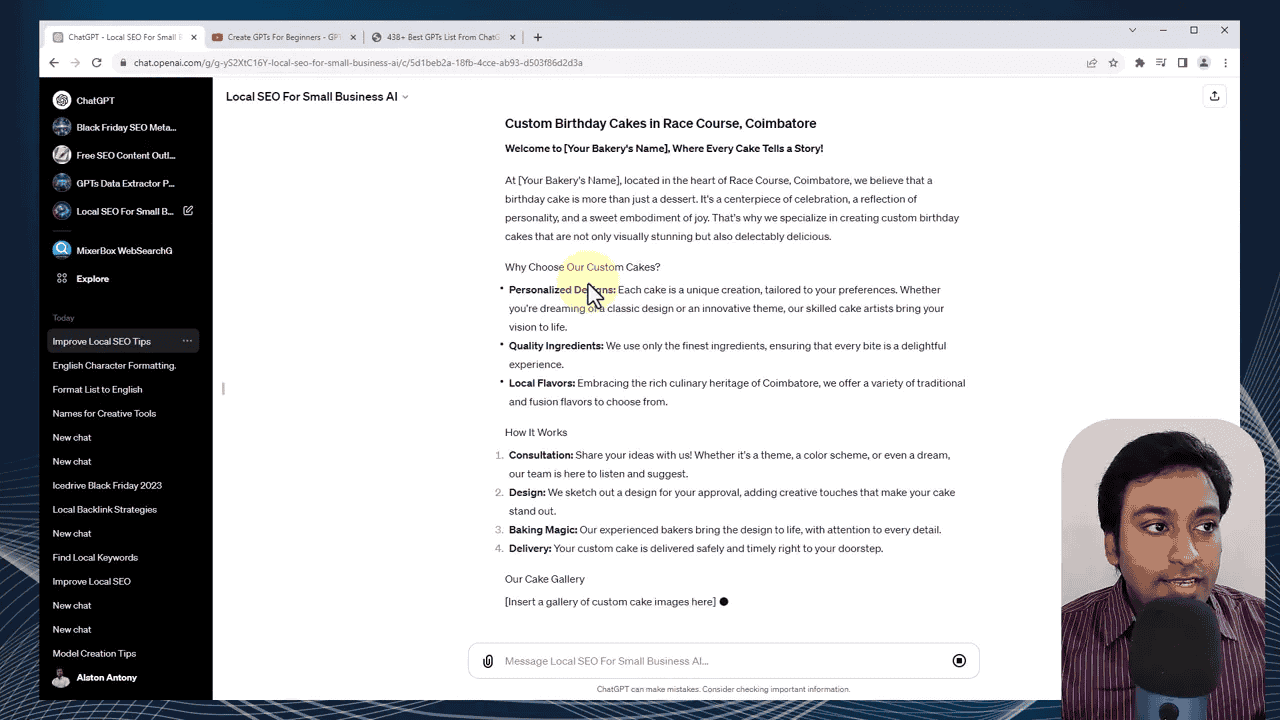
The output was not a blog post. It read like a proper service page, written with conversion in mind:
Title: “Custom Birthday Cakes in Race Course, Coimbatore — [Your Bakery Name]”
Introduction: Localized, warm, specific to Coimbatore. It framed the cake as a centerpiece for celebration, not just a food item. The kind of copy that makes a customer feel understood.
How it works: A three-step process section (Consultation, Design, Baking and Delivery) that builds confidence and reduces purchase anxiety.
Our cake gallery: A placeholder section with guidance on what photos to include.
Customer testimonials: A pre-built testimonial section with placeholder text showing the format.
Call to action: A clear “Order Your Cake” prompt.
The GPT also generated SEO considerations alongside the content:
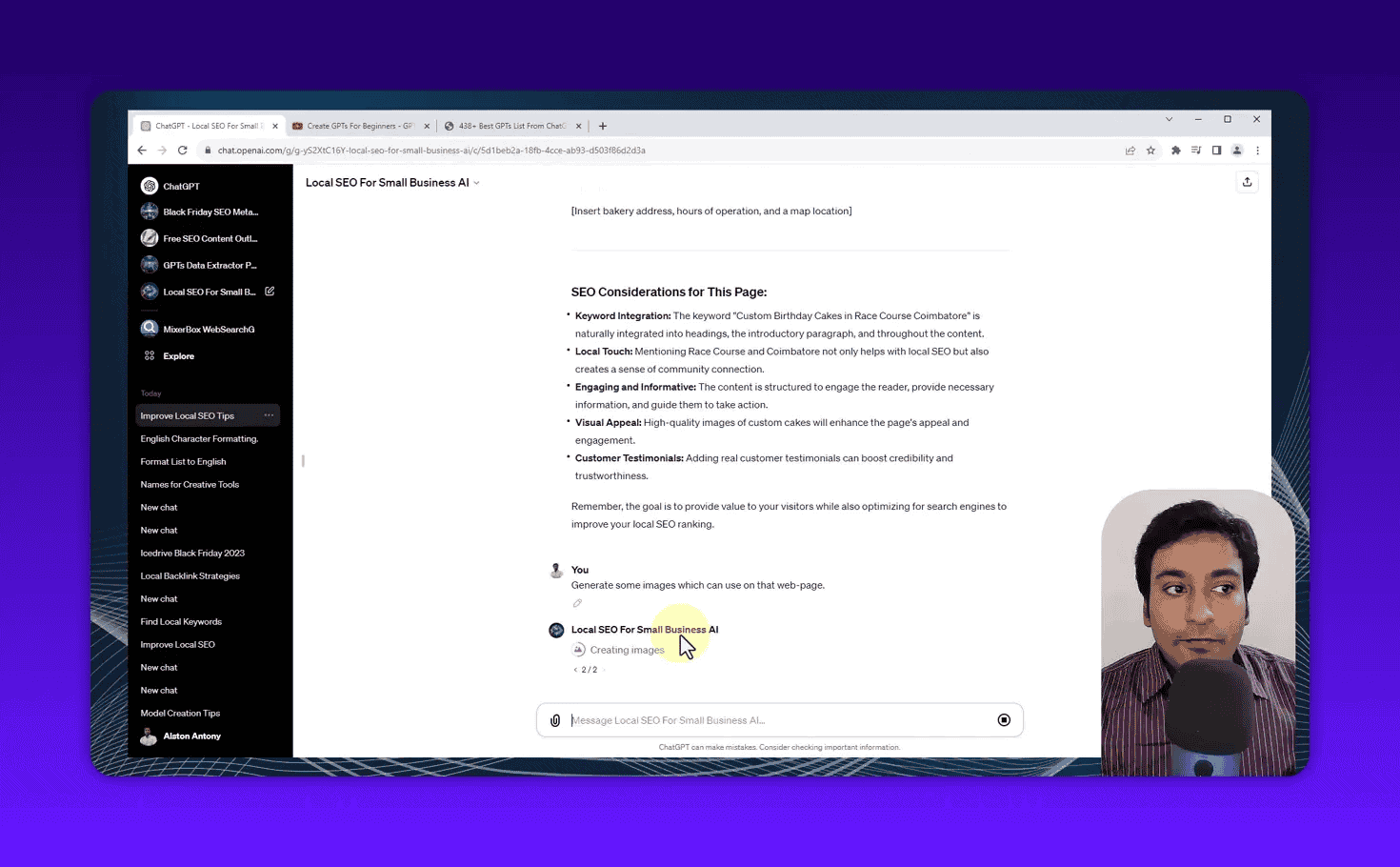
It flagged where to place the keyword in the title, in the first paragraph, in the H2 headings, and in the meta description. It noted that customer testimonials improve conversion and also add unique user-generated content that search engines value.
You would still need to replace placeholders with your real business name, real photos, and real testimonials. But the structure, the copy direction, and the SEO framework are all there. For a small business owner building their first service page, this is a significant head start.
Google Business Profile Optimization
Your Google Business Profile (formerly Google My Business) is the single most important local SEO asset you have. A fully optimized profile appears in the Google Map Pack, the three-business block that shows up above organic results for most local searches. If you are not there, you are invisible for the searches that matter most.
The GPT handles GBP optimization as a separate workflow. When you ask about it, the output covers:
Profile completeness. Every field filled out: business name, address, phone, website, hours, category, description. Missing fields directly hurt your map ranking.
Category selection. Choosing the right primary category and adding relevant secondary categories. For a bakery, “Bakery” is the primary. “Custom Cake Shop” or “Wedding Cake Shop” might be strong secondary categories depending on your specialization.
Photo strategy. The GPT recommends adding photos in categories: exterior (so customers recognize the building), interior, team, products, and customer experiences. It also notes that businesses with photos get 42% more direction requests and 35% more website clicks, referencing Google’s own data.
Review management. How to ask for reviews without violating Google’s policies. How to respond to both positive and negative reviews in a way that signals trust to potential customers and to Google’s algorithm.
Q&A section. Seeding your own questions and answers in the Q&A section of your profile. This controls the narrative and ensures the most important information appears for anyone who browses before contacting you.
Posts. Using Google Business Profile posts to share offers, events, and updates. These posts appear directly in your profile and act as a free ad to everyone who views your listing.
Building Local Backlinks
Backlinks remain one of the strongest ranking signals in local SEO. But the link-building advice you find online is mostly written for large websites: guest posts, digital PR, broken link building. None of that is realistic for a bakery owner in Coimbatore who has one location and zero marketing team.
I asked the GPT: “What backlinks can I get for my small business?”
The response was grounded in reality. It did not suggest reaching out to Forbes or trying to get a link from Wikipedia. It focused on what actually works for local businesses:
Community involvement. Sponsoring a local school sports team or community event. Local news sites and event pages often link to sponsors. These links are genuinely valuable because they are geographically relevant.
Local chambers of commerce. Joining the Coimbatore Chamber of Commerce or your local business association typically includes a directory listing with a link. These directories are trusted by Google because they require real business verification.
Educational institutions. If you supply cakes for school events or college functions, the institution’s website often lists vendors or partners. An .edu or .ac.in link from a local institution carries real weight.
Supplier and vendor relationships. Your flour supplier, your packaging vendor, your equipment provider. Many business websites list their customers or partners. A simple request can get you a link from a site that likely has strong local authority.
Local bloggers and food writers. In most cities, there are food bloggers and lifestyle writers covering the local restaurant and bakery scene. A free tasting or a behind-the-scenes visit can turn into a review post with a link.
The GPT then asked what specific area I wanted to go deeper on. I chose social media, and it immediately pivoted into a detailed social media guide.
Social Media Profile Setup for Local SEO
Social media profiles are a backlink source that most small businesses ignore. Every major social platform (Facebook, Instagram, LinkedIn, Pinterest) allows you to add your website URL. These links contribute to your backlink profile, and the platforms themselves have strong domain authority.
More importantly, consistent NAP data across all social profiles strengthens your local SEO signals. Google cross-references your Name, Address, and Phone number across the web. If your Instagram says “Race Course Rd” and your Google Business Profile says “Racecourse Road” and your website says “Race Course Street,” those inconsistencies dilute your authority. The GPT makes this explicit.
I asked: “I run a small bakery in Racecourse, Coimbatore. Can you suggest some sample content to use in my social media profile setup?”
The GPT produced a complete social media setup framework:
Profile picture guidance. Use your bakery logo or a clean photo of your storefront. Consistent across all platforms.
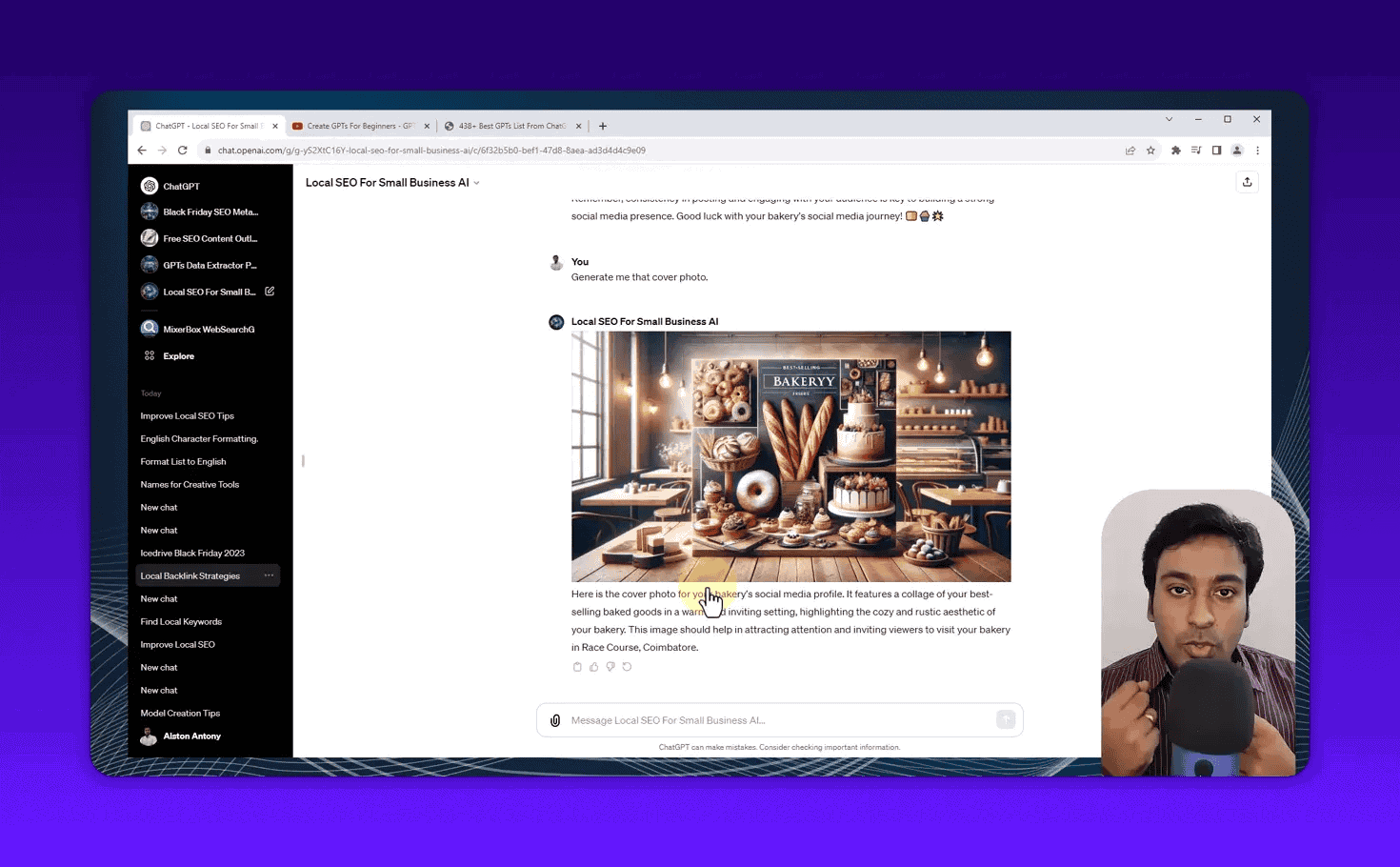
Cover photo recommendation. A collage of your best-selling baked goods or a well-lit shot of your bakery interior.
Bio/Description. The GPT wrote a localized bio: “[Bakery Name] — Your favourite artisan bakery in Race Course, Coimbatore. Fresh bread, custom cakes, and local sweets made with love. Order online or visit us at [address].” It included suggested hashtags and contact format.
Content posting schedule:
- Daily specials (photo of the day’s featured item)
- Behind-the-scenes content (baking process, team features)
- Customer spotlight posts with permission (“Thanks to Priya for sharing this lovely photo of her daughter’s birthday cake”)
- Throwback Thursday (older cake designs or business milestones)
- Team Monday (introduce your staff)
- Foodie Friday (showcase your most photogenic item of the week)
Local hashtag strategy. Platform-specific hashtag recommendations combining product hashtags (#CustomCakes), location hashtags (#Coimbatore, #RaceCourse), and seasonal tags (#DiwaliSweets, #ChristmasCakes).
This is a functional content calendar, not generic “post consistently” advice. It is specifically constructed around the business type and location.
Image Generation Inside the GPT
One feature that surprised me: the GPT can generate images directly. Since it runs on ChatGPT with DALL-E integration, you can ask it to create visuals for the pages and profiles it just helped you plan.
I asked: “Generate me a cover photo I can use on social media for my bakery.”
The output was a photorealistic collage showing artisan baked goods: decorated cakes with intricate icing, fresh bread loaves, and pastries arranged in a way that looks professionally styled. Not perfect for every business, but genuinely usable as a starting point or a placeholder while you get real photos taken.
You can regenerate as many times as you want. Each attempt produces a different image. The conversation history saves everything, so you can come back and continue refining from where you left off.
For small business owners without budget for professional photography, this gives you something to work with immediately. For those who plan to hire a photographer, the GPT-generated images give the photographer a clear visual brief to match.
Tips for Getting the Most Out of the GPT
The quality of output scales directly with the quality of your input. Here is what I learned from running it through multiple scenarios:
Be specific from the first message. “I run a small bakery” gets generic output. “I run a small artisan bakery on Race Course Road, Coimbatore, specializing in custom birthday cakes and wedding cakes for a premium clientele” gets output that is specific enough to publish.
Go one topic at a time. The GPT handles depth well when you stay focused. Ask about keyword research, get the full picture, then shift to subpages. Jumping between topics in one message produces shallower output on each.
Ask for the specific output you need. “Give me keyword ideas” is fine. “Give me a table of 10 long-tail keywords with estimated search intent and suggested page titles” is better. The more you specify the format, the more useful the result.
Push it deeper. When the GPT gives you a strategy overview, your next message should be “go deeper on point 3.” This forces specificity. The general-to-specific workflow is where the tool performs best.
Provide existing data if you have it. If you already have a Google Business Profile, paste your current description in and ask it to improve it. If you have existing keyword data from Google Search Console, share it. The GPT uses whatever context you provide.
Iterate. The first draft of anything it produces is a starting point. Ask it to rewrite a bio with a different tone, generate three variations of a page headline, or tighten a paragraph. It refines well.
What the GPT Cannot Do
To be direct about limitations:
It cannot access your actual search data. It cannot log into Google Search Console, pull your current rankings, or see your actual traffic. Everything it recommends is based on general local SEO principles applied to your stated context.
It does not build your website. It gives you the content and the strategy. Implementation is still on you.
It does not guarantee rankings. No tool does. Local SEO results depend on competition, domain age, Google Business Profile history, and dozens of other factors the GPT has no visibility into.
The backlink opportunities require real outreach. The GPT tells you where to look for backlinks. You still need to contact local chambers, email bloggers, and build those relationships yourself.
Image quality is limited. The generated images work as placeholders or mood boards. Real product photography from a professional is still the gold standard for a local business trying to look premium.
What it does is remove the knowledge barrier. Most small business owners are not doing local SEO because they do not know where to start, not because they lack the time or willingness to try. This GPT answers “where do I start?” at every stage of the local SEO process.
How This Compares to Hiring an Agency
A mid-range local SEO agency charges $500 to $1,500 per month. For that fee, you typically get:
- A monthly report with keyword rankings
- A few citations added per month
- Occasional blog posts (usually low-effort)
- Someone to email when you have questions
The free Local SEO GPT cannot publish your content, build your citations automatically, or track your rankings over time. But it can give you a level of strategic depth, local specificity, and actionable guidance that many agencies never deliver.
The combination that works: use the GPT to build your strategy, understand your keywords, and generate your content frameworks. Use your own time (or a part-time VA) to implement. Check your results monthly in Google Search Console. Free keyword research is available right inside Google Search Console.
If you need to hire an agency eventually, you will be a far better client because you will know what questions to ask, what deliverables to expect, and what good results actually look like.
The Bigger Picture: AI as Your Local SEO Co-Pilot
We are at an early stage of AI-powered marketing tools for small businesses. The current GPT is beta software built in a few hours. It will keep improving.
What it represents is more important than its current feature set: the democratization of strategic marketing knowledge. The keyword research process, the subpage content strategy, the social media setup framework, the backlink source identification, the Google Business Profile optimization checklist. All of that used to require either expensive consultants or years of learning. Now you can access it through a free chat interface.
If you want to understand how AI is changing search more broadly, read my guide on how AI search engines work and what it means for your SEO strategy.
For business owners who want to go further with SEO tool knowledge beyond what an AI assistant can provide, the best SEO tools comparison covers 25 tools tested across 100+ real websites, with honest assessments at every budget level.
Frequently Asked Questions
Is the Free Local SEO GPT Really Free?
Yes. You need a free ChatGPT account from OpenAI. The GPT itself is free to access. ChatGPT has usage limits on free accounts, but the GPT is not a paid add-on.
Do I Need SEO Experience to Use It?
No. The GPT is designed for business owners with no SEO background. You describe your business and ask questions in plain language. It explains the reasoning behind every recommendation.
Can It Help with Google Business Profile Optimization?
Yes. It covers the full GBP workflow: completing your profile, choosing categories, managing photos, responding to reviews, seeding the Q&A section, and using Posts.
Does the GPT Work for Businesses Outside India?
Yes. The bakery in Coimbatore was a demonstration example. The GPT adapts to any business type and location worldwide. A landscaper in Leeds, a dentist in Dallas, or a cafe in Toronto would get equally localized output.
How Often Should I Use It?
Use it as a starting point for any new local SEO task. Building a new page? Start with the GPT to define the keyword and content structure. Launching a new social profile? Ask it for a bio framework. Thinking about backlinks? Run through the local opportunity brainstorm. It is more useful as an ongoing reference than as a one-time audit.
Can I Give Feedback to Improve the GPT?
Yes. Leave feedback in the comments below or connect through the community. Community input directly shapes how future versions are built.
Final Thoughts
Local SEO has always been achievable for small businesses without an agency. The knowledge was never the secret sauce. The barrier was always access to that knowledge in a form that was specific, actionable, and understandable without an SEO background.
The free Local SEO GPT removes that barrier. It will not do the work for you. But it will tell you exactly what work to do, how to do it, and why it matters, tailored to your specific business and location.
Give it a try. Tell it your business type and city. Ask it one specific question. See what comes back.
If you want to explore more free SEO tools built for practical use, or want to understand the full landscape of SEO tools available at every budget, those resources are there when you are ready.